
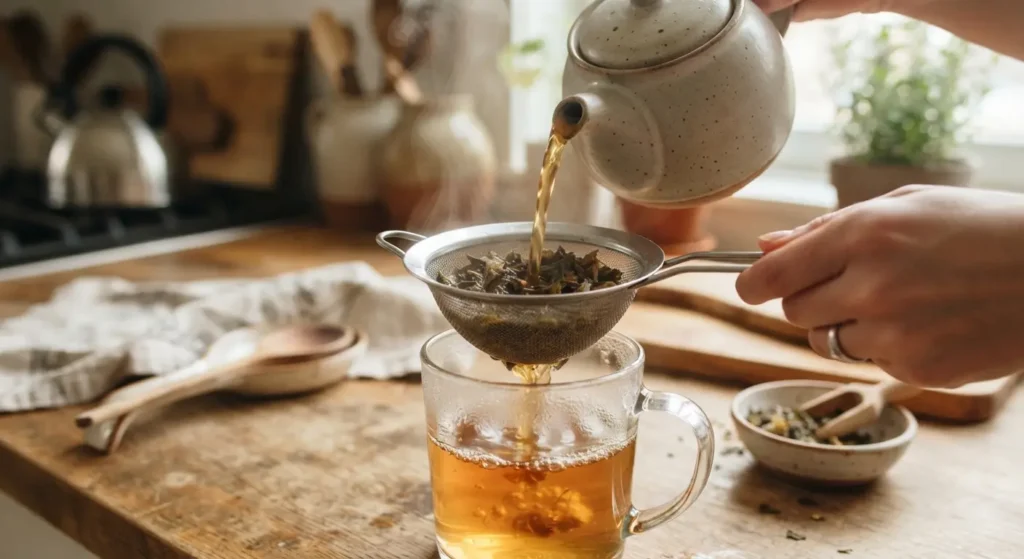
Making cannabis tea means decarboxylating your flower, combining it with a fat source, and steeping the mix in hot water for 5 to 10 minutes. Skip the decarboxylation step and the tea will taste like cannabis but do almost nothing. Skip the fat and most of the cannabinoids never make it into your cup.
This guide walks through both steps, explains how much flower to use, and covers a mistake that trips up almost everyone the first time they try it.
Key Takeaways
- Cannabis tea needs decarboxylated (heat-activated) flower plus a fat source like butter, coconut oil, or whole milk, because THC binds to fat, not water.
- Onset typically takes 45 to 90 minutes, and effects can last 4 to 6 hours, so resist the urge to brew a second cup right away.
- Massachusetts limits adult-use edible servings to 5 mg of THC each, under state cannabis regulations, which is a useful benchmark for homemade dosing.
- A common starting ratio is about 1 gram of decarboxylated flower per 1 to 2 cups of tea, adjusted down for a first try.
- Store leftover infused butter or tea in the refrigerator, in a sealed and labeled container, out of reach of children.
Why Cannabis Tea Needs a Fat Source First
THC is fat-soluble, not water-soluble, which is why steeping raw cannabis in plain hot water pulls out very little of it. Cannabinoids are highly lipid-soluble compounds, meaning they bind readily to fat molecules but barely dissolve in water on their own.
That is why nearly every cannabis tea recipe calls for a tablespoon of butter, coconut oil, or full-fat milk per cup. The fat acts as a carrier, giving THC and CBD something to attach to as they steep into the liquid. Skipping this step is the single most common reason a homemade cannabis tea turns out weak or ineffective.
Step 1: Decarboxylate Your Cannabis
Raw cannabis flower contains THCA, an inactive compound that will not get you high on its own. Heat converts THCA into THC by knocking loose a carboxyl group, a chemical reaction called decarboxylation. Only the decarboxylated form crosses into the bloodstream in a way that produces psychoactive effects.
Temperature and time both matter here. Research on THCA conversion has found that peak THC formation happens fairly quickly at higher heat.
But total THC content can drop by roughly half within 40 minutes at that same temperature. More time in the oven is not automatically better once the cannabinoids have converted.
A practical home method:
- Grind your flower coarsely and spread it in a single layer on a parchment-lined baking sheet.
- Bake at a moderate oven temperature until the flower turns light brown and smells toasted, checking a few minutes early rather than late.
- Let it cool before handling, then move on to brewing.
THCA also decarboxylates faster than CBDA at the same temperature, based on peer-reviewed chromatography research. This is part of why THC-focused and CBD-focused decarb methods use slightly different timing in professional settings.
Step 2: Brew the Tea
Once your flower is decarboxylated, the brewing part is straightforward.
- Boil 1 cup of water per serving in a small saucepan.
- Add 1 tablespoon of unsalted butter, coconut oil, or a splash of whole milk, and stir until it dissolves.
- Add your decarboxylated cannabis, either loose or wrapped in a tea bag or infuser, along with any regular tea you’re using as a base.
- Reduce to a gentle simmer for 5 to 10 minutes, stirring occasionally.
- Strain through a fine mesh strainer to remove plant matter.
- Sweeten to taste and serve warm.
How Much Cannabis Should You Use?
A common starting ratio is 1 gram of decarboxylated flower per 1 to 2 cups of tea. The actual dose you end up drinking is still hard to pin down exactly. Flower potency varies by strain and batch, and steeping doesn’t extract 100% of the available THC into the liquid.
Here’s a way to think about it. If your flower tests at 20% THC, 1 gram contains roughly 200 mg of total THC. Massachusetts caps adult-use edible servings at 5 mg of THC per serving, under state Cannabis Control Commission rules. That single gram theoretically holds enough THC for around 40 standard servings, spread across however many cups you brew.
That gap between “total THC in the flower” and “one safe serving” is exactly why homemade tea calls for caution on a first attempt. Start with less flower than you think you need, and treat the first cup as a test batch rather than a full dose.
What to Expect: Onset Time and How Long It Lasts
Cannabis tea is absorbed through the digestive system, like an edible, rather than through the lungs. Oral THC has a much lower bioavailability than inhaled THC, generally in the range of 4% to 12%, compared to roughly 10% to 35% when smoked or vaporized.
Onset for oral cannabis is typically delayed to somewhere in the 45- to 90-minute range, sometimes longer if you’ve eaten recently. Effects can last 4 to 6 hours.
Ingested THC also converts in the liver to a metabolite called 11-OH-THC, at a much higher ratio than inhaled THC produces. That metabolite is considerably more potent. This is part of why tea and other edibles can feel stronger and last longer than smoking the same amount of flower.
This delay causes the most common mistake with cannabis tea: drinking a cup, feeling nothing after 30 or 40 minutes, and brewing a second one. Both doses then hit around the same time. Wait the full 90 minutes before deciding you need more.
Flavor Variations and Add-Ins
Plain cannabis tea has a grassy, herbal taste that not everyone loves. A few ways to adjust it:
- Ginger and lemon: Simmer fresh ginger slices alongside the cannabis for a warming, cold-weather cup.
- Cold brew: Strain the finished tea and refrigerate it overnight for a smoother, milder iced version.
- CBD-forward blend: Using a CBD-dominant strain produces a calmer, lower-impairment cup that’s easier to enjoy earlier in the day.
Skip the Guesswork: Pre-Dosed Alternatives
Homemade cannabis tea is a fun project, but the dosing is approximate by design. If precise, consistent servings matter more to you than the process, a pre-dosed tincture or low-dose edible removes the guesswork. Add a dropperful of tincture to a regular cup of tea and you get a known milligram amount every time, without decarboxylating anything yourself. Our team can point you toward options suited to a first try on our menu.
Storing Cannabis Tea and Ingredients Safely
Any infused butter or leftover tea should go straight into the refrigerator. General USDA food-safety guidance on butter recommends refrigerated storage, used within about one to two months, or freezing for longer-term storage. Don’t leave it out at room temperature for more than a day or two. Infused butter follows the same basic food-safety timeline as regular butter.
Storage location matters as much as temperature. Poison control centers have reported a sharp rise in accidental cannabis edible ingestions by young children over the past two decades.
Pediatric guidance recommends keeping any cannabis product, including homemade tea or infused butter, in a labeled, sealed container. Store it out of children’s reach and separate from regular food, the same way you’d handle anything you wouldn’t want a child mistaking for a snack.
Cannabis Tea vs. Other Edibles
Homemade Cannabis Tea | Dispensary Low-Dose Edible | Tincture Added to Tea | |
Dosing precision | Approximate, varies by batch | Exact, labeled per serving | Exact, by the drop |
Onset time | 45–90 minutes | 45–90 minutes | 45–90 minutes (oral) |
Effects duration | 4–6 hours | 4–6 hours | 4–6 hours |
Prep effort | Decarb + brew required | None | Minimal, just add to a drink |
Brew Smart, Sip Slow
Cannabis tea rewards a little patience, both in the kitchen and after you drink it. Decarboxylate properly, use a real fat source, and start with less flower than you think you need. Give the first cup a full 90 minutes before deciding whether you want a second one.
Once you’ve got the ratio dialed in for your own tolerance, cannabis tea becomes one of the more relaxing, low-key ways to enjoy cannabis at home.
Explore The Verb is Herb’s Edibles and Tinctures
If you’d rather start with something pre-measured, our edibles and tinctures come in exact, labeled doses, no decarboxylating required. Stop by our Easthampton location or check our menu to see what’s in stock this week.
FAQ
Can I use cannabis stems or trim instead of flower for tea? Yes, though stems and trim generally contain less THC per gram than flower, so tea made from them tends to be milder. Decarboxylation still applies the same way.
Does cannabis tea get you as high as smoking? Cannabis tea is absorbed orally, so it takes longer to kick in than smoking does. Many people describe the effect as more body-forward and longer-lasting for the same amount of flower.
How long does homemade cannabis tea last in the fridge? Plan to use it within a few days for best quality and safety, similar to any homemade infusion involving dairy or butter. If it smells off or looks separated, discard it.
Is it legal to make cannabis tea at home in Massachusetts? Adults 21 and older can legally possess and use cannabis purchased from a licensed Massachusetts dispensary, including preparing it at home for personal use. Public consumption rules and possession limits still apply, so check current Cannabis Control Commission guidance if you’re unsure.
Please Consume Responsibly.
For use only by adults 21 years of age or older. Keep out of the reach of children. Marijuana should not be used by women who are pregnant or breastfeeding.
This product has not been analyzed or approved by the Food and Drug Administration (FDA). There is limited information on the side effects of using this product, and there may be associated health risks. Marijuana use during pregnancy and breast-feeding may pose potential harms. It is against the law to drive or operate machinery when under the influence of this product. KEEP THIS PRODUCT AWAY FROM CHILDREN. There may be health risks associated with consumption of this product. Marijuana can impair concentration, coordination, and judgment. The impairment effects of Edibles may be delayed by two hours or more. In case of accidental ingestion, contact poison control hotline 1-800-222-1222 or 9-1-1. This product may be illegal outside of MA.