
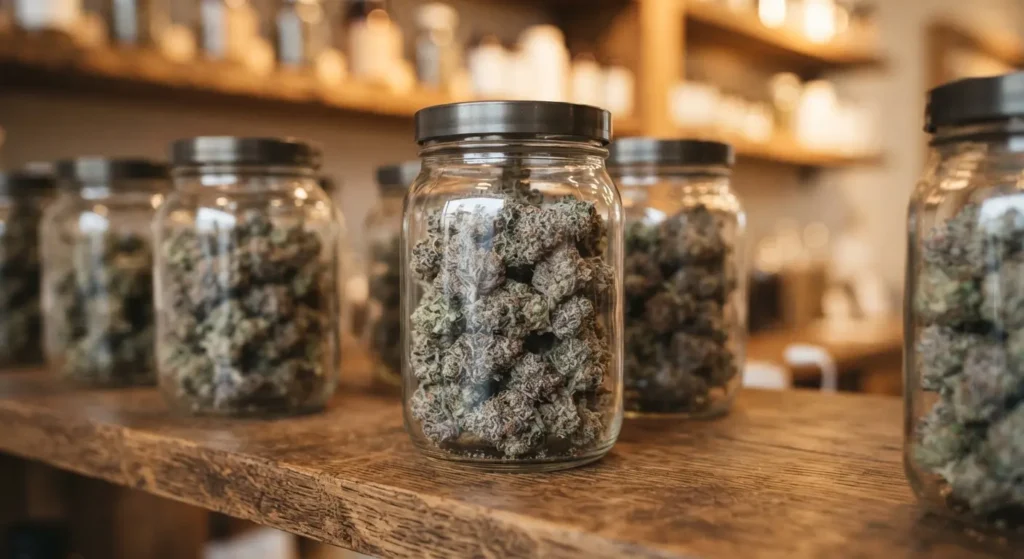
Hybrid weed strains are cannabis varieties bred by crossing indica and sativa plants to blend their traits. Most flower sold in Massachusetts dispensaries today is technically a hybrid, whether the label says so or not. This guide breaks down how hybrids are classified, what actually drives their effects, and how to pick one that fits what you want from your evening.
Key Takeaways
- A hybrid strain comes from crossbreeding indica and sativa plants, and decades of crossbreeding mean almost every strain on a modern menu qualifies.
- Hybrids are usually grouped as indica-dominant, sativa-dominant, or balanced, based on which parent’s traits show up more.
- Genetic research has found that indica and sativa labels often don’t match a plant’s actual chemistry, so the label alone won’t tell you how a strain will feel.
- Terpenes and cannabinoid ratios, not the indica/sativa/hybrid label, are the more reliable predictors of a strain’s effects.
- Massachusetts requires every product to carry lab-tested cannabinoid data, so check the Certificate of Analysis, not just the strain name.
What Does “Hybrid” Actually Mean?
A hybrid cannabis strain is created when growers cross-pollinate an indica plant with a sativa plant. Breeders repeat this process across generations to combine specific traits, like flavor, yield, or a particular effect profile.
Indica plants are short and bushy, originally found in dry regions of Central Asia. Sativa plants grow tall and narrow-leafed, tracing back to warmer regions like South America and Southeast Asia. When cultivators cross the two, the resulting hybrid inherits genetics from both lineages.
Cross-breeding has been standard practice in the cannabis industry for decades. A 2015 genetic study of 81 marijuana samples, published in PLOS ONE by researchers using genome-wide SNP data, found that extensive hybridization has blurred the line between “pure” indica and sativa populations. In practice, that means most strains on a dispensary shelf, regardless of their label, carry mixed ancestry.
The Three Types of Hybrid Weed Strains
Not all hybrids are created equal. Breeders typically describe hybrids by which parent strain’s traits show up more strongly in the final plant.
Indica-Dominant Hybrids
An indica-dominant hybrid carries more indica genetics than sativa. These strains tend to lean toward the physically relaxing, body-heavy effects associated with indica lineage, while keeping some of the mental clarity sativa genetics can add.
Sativa-Dominant Hybrids
A sativa-dominant hybrid carries more sativa genetics than indica. These strains tend to lean toward the more energizing, cerebral effects associated with sativa lineage, tempered by a touch of indica’s physical calm.
Balanced Hybrids
A balanced hybrid, sometimes called a 50/50 hybrid, comes from roughly equal indica and sativa lineage. Growers breed these for a middle-ground experience that doesn’t lean heavily toward either side.
Why the Indica, Sativa, and Hybrid Labels Don’t Tell the Whole Story
The indica, sativa, and hybrid system is useful shorthand, but it isn’t a precise science. Researchers have repeatedly found that these labels don’t reliably predict a plant’s chemical makeup.
A phytochemical study published in PLOS ONE analyzed cannabis samples across six US states and found that lab-confirmed chemical clusters didn’t consistently line up with the Indica, Sativa, or Hybrid names printed on the packaging. Two products both labeled “hybrid” can test with very different cannabinoid and terpene profiles. The researchers found that certain labels showed some statistical association with specific chemical clusters, but the overlap was far from exact.
This doesn’t mean the labels are useless. It means they’re a starting point, not a guarantee. A more reliable approach is to look past the category name and check the actual lab data on the product.
What Actually Shapes a Hybrid’s Effects
Two hybrids can share the same name and still feel different from each other. The real drivers are terpenes and cannabinoid ratios, not the indica/sativa/hybrid category.
Terpenes are the aromatic oils that give cannabis its scent. Myrcene, often described as earthy or musky, has shown sedative and analgesic properties in animal studies. Limonene, with a bright citrus smell, has been linked to reduced anxiety-like behavior in lab research. Caryophyllene, which smells peppery, binds to CB2 receptors and has shown anti-anxiety effects in preliminary studies.
These terpenes are thought to interact with cannabinoids like THC and CBD in what’s commonly called the “entourage effect.” A comprehensive review of the research found this theory remains scientifically unproven, even though it’s widely used in marketing. Treat it as a working hypothesis, not a settled fact.
The THC-to-CBD ratio also matters. Products higher in THC tend to produce stronger intoxicating effects, while CBD is non-intoxicating and may soften some of THC’s more intense qualities for some people.
Popular Hybrid Strains on Today’s Menus
Some hybrid names show up again and again on dispensary menus because they’ve built a reputation over time.
- Wedding Cake — an indica-leaning hybrid known for a relaxed, clear-headed feel. Read our full review of Wedding Cake by Evergreen Industries from our own shelf.
- Gelato — a widely grown hybrid known for a creamy, dessert-like flavor profile.
- Blue Dream — a balanced hybrid known for a mellow, approachable experience that suits many tolerance levels.
- GG4 — a pungent hybrid that tends to sit closer to the middle of the energizing-to-relaxing spectrum.
Strain names can shift in meaning as different growers use them, so the lab data on the specific batch you’re buying matters more than the name on its own.
How to Choose the Right Hybrid for You
Picking a hybrid comes down to matching the strain’s likely effects to what you actually want out of the moment.
- For evening wind-down: look for an indica-dominant hybrid with higher myrcene content.
- For daytime focus: look for a sativa-dominant hybrid with higher limonene or pinene content.
- For a first try: start with a balanced hybrid and a low dose, then wait before taking more.
- For new consumers: begin with a single inhalation of flower or a low-dose edible, then wait at least 15 minutes for inhaled products or up to two hours for edibles before deciding whether to take more.
Everyone’s tolerance and body chemistry differ, so what works for a friend may not work the same way for you. Keep notes on which strains and doses felt right, and adjust gradually from there.
Reading the Label: What Massachusetts Requires
Massachusetts law gives you a way to check a strain’s actual makeup instead of relying on the category name alone.
Every product sold at a licensed Massachusetts dispensary must carry a lab-tested cannabinoid profile, confirmed by an independent testing laboratory. As of a May 2026 bulletin from the Massachusetts Cannabis Control Commission, the state now audits shelf products to confirm labeled THC potency falls within 75 to 125 percent of the lab-tested result. A product labeled at 15% THC, for example, must test between 11.25% and 18.75% THC to stay on shelves.
Edible products carry their own limits under state regulation 935 CMR 500.150: no more than 5.5 mg of active THC per serving, and no more than 110 mg per package. Most dispensary products include a QR code linking to the full Certificate of Analysis, which lists cannabinoid and, often, terpene content for that specific batch.
Checking this data takes a few extra seconds and gives you a far more reliable picture than the strain name alone.
Hybrid vs. Indica vs. Sativa
Indica | Sativa | Hybrid | |
Plant shape | Short, bushy | Tall, narrow-leafed | Mixed traits |
Typical association | Physical relaxation | Mental energy | Blend of both |
Best known for | Evening use | Daytime use | Flexible, varies by dominance |
Reliability of label | Often mismatched to chemistry | Often mismatched to chemistry | Most common category by volume |
What to check instead | Terpene and cannabinoid data | Terpene and cannabinoid data | Terpene and cannabinoid data |
Trust the Lab Report as Much as the Label
Hybrid weed strains make up the bulk of what’s sold in dispensaries today, and for good reason. Breeders have spent decades combining traits to give consumers more tailored options than a single indica or sativa plant could offer on its own.
The category name is a starting point, not the whole answer. The terpene profile, cannabinoid ratio, and lab-tested data on the specific batch in front of you will tell you far more about how it’s likely to feel.
Explore The Verb is Herb’s Hybrid Selection
Our shelves rotate regularly with hybrid flower from local growers, each backed by a full Certificate of Analysis. Stop by our Cottage Street location or browse our current menu to see what’s in stock this week.
Frequently Asked Questions
Is hybrid weed stronger than indica or sativa? Strength depends on THC content and the specific plant, not the indica, sativa, or hybrid category. A hybrid can test higher or lower in THC than an indica or sativa, so check the lab label for potency rather than assuming based on the category.
Can a hybrid strain still be described as indica-dominant or sativa-dominant? Yes. Most hybrids lean toward one parent strain’s traits and are commonly labeled indica-dominant or sativa-dominant, while a smaller share are marketed as balanced or 50/50.
How do I know if a hybrid will make me feel sleepy or energized? Check the terpene profile on the Certificate of Analysis if it’s available. Myrcene-heavy strains tend to lean relaxing, while limonene- or pinene-heavy strains tend to lean more energizing.
Are hybrid strains legal for adult use in Massachusetts? Yes. Adults 21 and older can purchase hybrid, indica, and sativa cannabis products at licensed Massachusetts dispensaries, subject to state purchase limits.
What’s the difference between a hybrid strain and a landrace strain? A landrace strain is a naturally occurring, unhybridized variety from a specific region, such as an original Central Asian indica. A hybrid strain is deliberately cross-bred from two or more parent strains, and landrace strains are now rare in commercial markets.
Regulatory & Legal Notices
State Boundary Warning: Please note that adult-use cannabis products purchased in Massachusetts are subject to state laws. Cannabis products may not be transported across state lines under any circumstances. Keep all products locked, out of reach of children, and in their original sealed packaging during transit.
FDA Disclaimer: These statements have not been evaluated by the Food and Drug Administration. These products are not intended to diagnose, treat, cure, or prevent any disease or medical condition. All content provided in this guide is for educational and informational purposes only and should not be used as a substitute for professional health advice.