
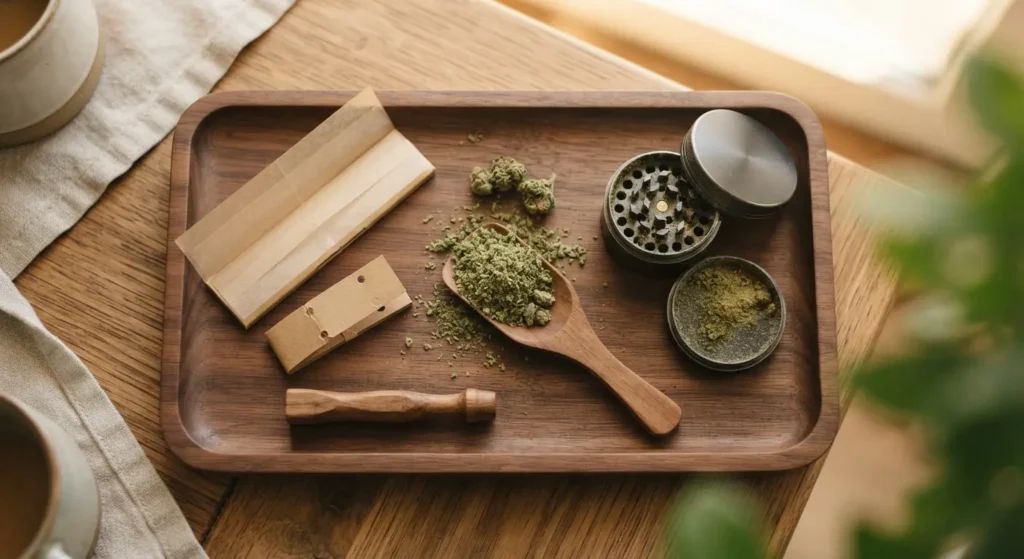
Learn how to roll a joint in six simple steps. You only need cured flower, rolling paper, and a small filter tip. We walk you through every move, from breaking down your bud to lighting an even cherry. With a little practice, your hands will get the feel for it quickly.
Key Takeaways
- Unbleached hemp papers give you the best grip so the sheet will not slip.
- A medium-coarse, fluffy grind keeps the cherry lit without canoeing.
- A W-fold crutch stops loose flower from getting into your mouth.
- Test the pull before lighting to confirm air passes freely through the tube.
- Touch the faster-burning side with a damp fingertip to stop side burns quickly.
What You Need Before You Start
Rolling goes much faster when your gear sits ready on a clean table.
Grab these basic tools:
- 0.5 to 1 gram of cured flower.
- Rolling papers. Unbleached hemp papers grip well. Wood pulp papers are thicker and roll easily. Rice papers burn slow, but they are thin and slick.
- A paper filter tip, also called a crutch.
- A two-piece or four-piece metal grinder.
- A flat rolling tray to catch loose crumbs.
- A packing tool like a chopstick, pen, or slim wooden poker.
You can look through our recreational dispensary menu to find fresh craft flower, rolling papers, and rolling trays before you begin.
The Parts of a Joint
Every part of a joint has a direct job to do. Knowing what each piece does helps you shape a clean roll.
The base holds your filter tip. This rolled card keeps the paper tube open so your fingers do not mash it flat.
The body holds your ground flower. The bud must sit evenly from the crutch to the open end. Soft spots cause the joint to bend, while tight knots block air.
The glue strip runs along the top inner edge of the paper. Most brands use natural acacia tree sap, known as gum Arabic. You can read about the properties of gum Arabic on Britannica. A light touch of moisture turns this sap into a strong seal.
The twisted tip seals the open end. Twisting the leftover paper locks the flower inside until you are ready to light up.
Step 1: Grind Your Flower for Steady Airflow
Good airflow starts with the way you grind your bud. Break the buds into smaller chunks by hand and set them between the grinder teeth.
Twist the lid four or five times. You want a medium-coarse, fluffy texture that looks like dried oregano. An even grind exposes a balanced surface area so the flower burns at the same rate.
Never turn your flower into fine dust. Powdered weed packs into a tight block that stops air from moving.
Pull out any hard stems before rolling. Stems poke holes right through thin paper, and seeds taste harsh when burned.
Step 2: Make Your Crutch with a W-Fold
A crutch stops loose bits of weed from pulling into your mouth. It also keeps your fingers from getting hot when the joint burns down.
Take a strip of unprinted cardstock. Make three or four small zig-zag folds at one end. These back-and-forth folds form a tiny “W” or accordion shape.
Roll the rest of the cardstock strip tightly around those folds. When you let go, it springs into a neat little cylinder. The inner folds catch loose plant crumbs while the outer ring keeps the airway clear.
Step 3: Load the Paper and Spread the Bud
Place your rolling paper flat on your tray. Make sure the sticky glue strip faces up and toward you.
Set your rolled crutch at one end of the center fold. Hold the crutch steady with your thumb.
Sprinkle your ground flower along the rest of the crease. Keep the layer flat from the crutch to the open tip. If you want a cone shape, taper the bud so it stays thinner by the crutch and widens toward the top.
Step 4: Shape the Cylinder
Pick up the paper with both hands. Hold the crutch with your dominant hand and support the flower with your other fingers.
Use your thumbs and forefingers to roll the paper up and down. This motion shapes the loose herb into a smooth, even cylinder.
Do not squeeze down hard. Squeezing packs the herb into dense spots that choke the draw. Spend twenty seconds shaping the flower into a neat tube before you try to tuck the paper.
Step 5: How to Roll a Joint with the Tuck and Roll
The tuck is the main skill when learning how to roll a joint. Fold the front unglued edge of the paper down and over your weed tube.
Tuck that paper edge behind the crutch first. The stiff cardstock gives your thumbs something firm to push against. Once the paper wraps behind the crutch, slide your thumbs along the seam to tuck the rest of the sheet behind the flower.
Roll the paper upward until only the glue strip shows. Lick the glue strip lightly. Too much moisture washes the gum away.
Press the wet seam down flat. Work from the crutch end out to the tip to push away air bubbles.
Step 6: Tamp the Top and Twist the Tip
Hold the joint upright with the crutch resting on the table. Tap the crutch gently against the table three times so gravity settles the flower column.
Take your packing stick and push down lightly on the open top. Stop pressing the moment you feel light resistance. Packing the top too firmly causes high draw resistance that makes pulling difficult.
Leave about half an inch of empty paper at the top. Twist that extra paper into a neat point. Your joint is now fully sealed.
Test Draw Resistance Before Lighting
Test your joint before you strike a flame. Put the crutch to your lips and take a dry pull while the joint is unlit.
This test shows how air moves inside the tube. Air should pull through easily, like sipping water through a wide straw. If the pull feels clogged, massage the joint gently between your thumbs to loosen tight spots.
Run your fingertips down the body. If you feel a soft spot, tap the joint on the table again or tamp the top to fill the pocket.
How to Fix Canoeing and Uneven Burns
Canoeing happens when one side of the paper burns faster than the other. This usually comes from uneven packing or lighting the tip too fast.
To fix an uneven run, dab your fingertip in water or saliva. Tap your wet finger right under the fast-burning side. The moisture cools down that hot edge so the slower side can catch up.
To prevent runs, take your time lighting the tip. Hold your flame just off the end without touching the paper directly. Spin the joint between your fingers so the heat lights the whole tip into a round, even cherry.
Differences Between Paper Types
The paper you buy changes how the joint rolls and burns. Different fibers offer different grip levels and burn rates.
Hemp papers use natural hemp fibers. They have a light texture that grips well in your fingers, which helps beginners hold the tuck. They burn at a steady pace and leave little flavor.
Wood pulp papers are the thickest sheets. They fold easily and do not rip, but they burn faster and leave grey ash behind.
Rice papers use pressed rice straw. They are ultra-thin and burn very clean, but they tear easily and slip in your fingers.
Beginners should start with unbleached hemp. Once your fingers learn the tuck, you can test thin rice papers for a slower burn.
Differences Between Joints, Spliffs, and Blunts
People often use these names for rolled cannabis, but they are different items. Each style uses distinct wraps and ingredients.
A joint holds ground cannabis flower inside a thin paper wrapper. It contains pure herb with no tobacco. Many adult consumers roll joints because pure flower gives a clean sensory experience without tobacco smoke.
A spliff mixes cannabis flower with loose tobacco inside a paper wrapper. Mixing tobacco introduces nicotine, which speeds up combustion and alters the sensory buzz. You can read about how nicotine affects your body on WebMD.
A blunt wraps cannabis flower inside thick tobacco leaves or brown cigar wraps. Blunts hold more flower and burn much slower than joints, but they also contain tobacco.
How to Store Your Joints
Store your joints properly if you roll a batch ahead of time. Dry air and sunlight leach moisture out of plant matter, which weakens natural terpenes and makes smoke taste harsh.
Keep your joints inside an airtight glass jar or a hard plastic travel tube. Store the container in a cool, dark drawer away from heating vents.
If you store joints for more than a few days, drop a two-way humidity control pack into the jar. This pack keeps the bud moist and stops the rolling paper from drying out. For consumer rules, age limits, and storage safety in Massachusetts, read the official guide on Mass.gov.
Legal Rules for Massachusetts Consumers
Adults who are 21 and older can legally buy and carry adult-use cannabis in Massachusetts. State law lets consumers carry up to one ounce of flower outside their home.
Keep your joints sealed in odor-proof, child-resistant containers while driving in your car. Store your cannabis products in your trunk or a locked glove box out of the driver’s reach.
Cannabis cannot cross state lines under any circumstances. Even if an adjacent state permits adult use, taking products over state lines remains illegal under federal law. Consume your cannabis only in private residences where smoking is allowed.
Frequently Asked Questions
Why does my joint keep going out?
Your joint goes out when air cannot reach the cherry. This happens when flower is ground into fine dust or packed down too hard. Grind your flower to a medium-coarse texture and pack lightly so oxygen can flow through.
Can I roll without a grinder?
Yes, you can pull whole buds apart by hand or cut them with clean kitchen scissors. Take your time to break the herb into small, uniform crumbs. Remove every stem so you do not poke holes through your paper.
What size rolling paper should a beginner buy?
Standard 1 1/4 size papers work best for beginners. They hold about half a gram of bud, which makes them easy to tuck and roll. King size papers are longer and take more practice to handle cleanly.
Stop by The Verb is Herb
Visit our dispensary at 74 Cottage St in Easthampton, MA for fresh flower, rolling papers, and rolling accessories.
Regulatory Disclaimers and Legal Notices
State line transport warning: Cannabis products purchased in the Commonwealth of Massachusetts are intended solely for local adult-use consumption by individuals 21 years of age or older. Do not cross state lines with cannabis. Transporting cannabis across state boundaries, borders, or through federal airspace is strictly illegal under United States federal law.
FDA and health disclaimer: These statements have not been evaluated by the Food and Drug Administration. This product is not intended to diagnose, treat, cure, or prevent any disease. Keep out of reach of children and pets. For adult use only (21+).