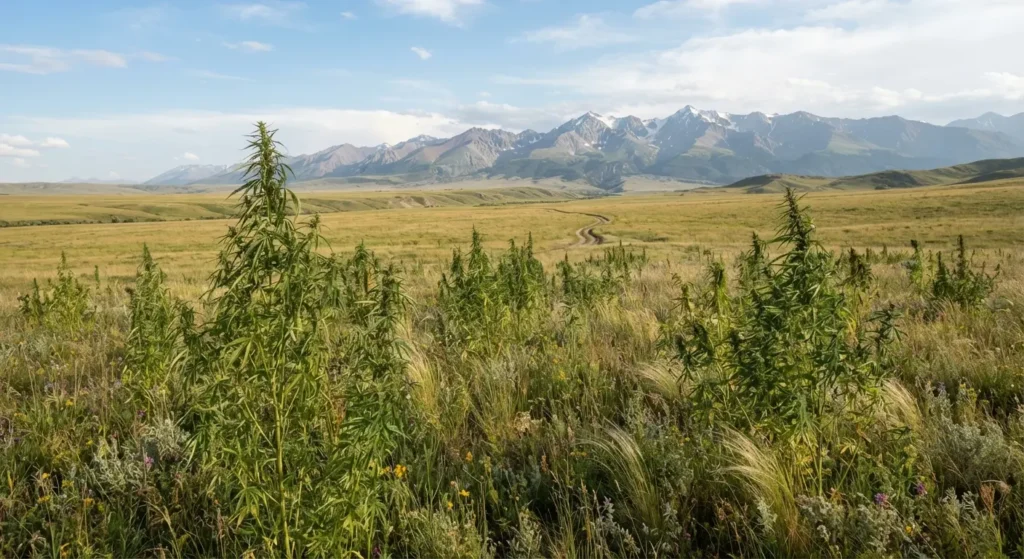
Wild cannabis grows naturally across Central Asia, in open grassland habitat stretching from the Himalayan foothills through Afghanistan and into western China. That’s the plant’s true native range. A second, very different kind of “wild” cannabis also grows across parts of the United States today, but it isn’t native. It’s feral hemp, sometimes called ditch weed, and it escaped from cultivated fields decades ago.
Both plants get called “wild cannabis” in casual conversation, which is where most of the confusion starts. This guide separates the two and explains where each one actually grows. It also covers what that has to do with the cannabis sold at a licensed Massachusetts dispensary today.
Key Takeaways
- True wild-type cannabis originates in Central Asia’s open steppe habitat, not in forests or deep wilderness.
- The cannabis growing wild in parts of the U.S. Midwest and Northeast is feral hemp, a descendant of fiber crops, not a native plant.
- Feral hemp typically contains very little THC and won’t produce a noticeable high.
- Federal and Massachusetts law draw a hard legal line between hemp and marijuana based on THC content. That line gets stricter in late 2026.
- Modern dispensary strains trace back, through generations of selective breeding, to wild-type genetics from Central and South Asia.
Where Cannabis Originally Came From
Cannabis is native to Central Asia. Researchers at the University of Vermont analyzed 155 fossil pollen studies across Asia. They traced the plant’s center of origin to that region. Wild-type populations there are tied specifically to steppe habitat: open, treeless grassland rather than forest.
The genus is old. Cannabis and its close botanical relative, hops (Humulus), split from a shared ancestor around 28 million years ago. Cannabis itself is estimated to have evolved in Central and East Asia roughly 27.8 million years ago.
Over tens of thousands of years, wild cannabis diverged into distinct regional populations. Plants in Central Asia, including Afghanistan, Pakistan, and the historical Turkestan region, developed the shorter, stockier form associated with the layman’s term “indica.” Plants further south and east, especially in India, developed into the taller, narrower-leafed form associated with “sativa.” Fossil pollen dating suggests these two population groups occupied separate ecological niches for at least 32,600 years before humans ever intervened.
Wild vs. Feral: Two Different Plants With the Same Name
“Wild cannabis” gets used two different ways, and mixing them up is where most confusion about this topic comes from.
- True wild-type cannabis is a native population that has never been domesticated. It grows on its own in its ancestral range, primarily Central and South Asia. It has existed there for tens of thousands of years without human cultivation.
- Feral cannabis, often called ditch weed, is a different story entirely. It’s a naturalized population descended from plants that were once deliberately cultivated, usually industrial hemp, and then escaped or were abandoned. Feral hemp isn’t native anywhere in North America.
The distinction matters because the two plants share almost nothing beyond genus. One is an ancient wild population shaped by tens of millions of years of natural selection. The other is a relatively recent escapee from 20th-century American agriculture. When people in the U.S. ask “where does wild cannabis grow,” they’re usually asking about the second one, so that’s where this guide heads next.
Where Feral Cannabis Grows in the U.S. Today
Most cannabis growing wild in the United States today is feral hemp, descended from fiber crops planted decades ago. It isn’t a naturally occurring native plant. It shows up most heavily across the Midwest, especially Indiana, Nebraska, and Iowa, along with pockets of the Northeast where hemp was historically farmed.
Feral cannabis favors disturbed ground: roadside ditches, field edges, riverbanks, and other spots where soil has already been turned over by human activity. It rarely spreads into untouched wilderness. Its seeds are notably hardy and can remain dormant in soil for years before sprouting. That’s part of why it keeps reappearing in the same locations decade after decade.
Why the DEA Spent Decades Pulling Roadside Plants
The federal government has treated feral hemp as a target for over 40 years. The Drug Enforcement Administration’s Domestic Cannabis Eradication/Suppression Program began in 1979 in Hawaii and California and expanded nationwide within a few years.
The scale of the effort has been large. A 1995 Department of Justice audit reviewed the program’s fiscal years 1993 and 1994. It found that a $10 million investment supported eradicating more than 72 million cannabis plants across four of the ten states reviewed. DEA program materials from that era define “ditchweed plants” as scattered, naturally wild-growing marijuana that nobody tends. Hand-cultivated plants, by contrast, are watered, pruned, or cloned.
The program is still active. In 2024, DEA-supported eradication efforts removed more than 5.28 million illegally cultivated cannabis plants nationwide, combining outdoor and indoor grows. Feral hemp remains a persistent presence in parts of the Midwest regardless. A plant that reseeds itself every year is difficult to fully remove from a landscape.
Does Wild or Feral Cannabis Get You High?
Generally, no. Feral hemp descends from industrial fiber crops bred for strong stalks and seed production, not for high THC content. That low-potency trait has carried through generations of uncultivated growth.
This is also why DEA’s own program materials distinguish ditchweed from cultivated marijuana in the first place. The two produce very different results for a user. A dispensary flower’s THC percentage is measured through independent lab testing before it ever reaches a shelf. A roadside plant has never been tested, tended, or bred for potency, and its cannabinoid content is unpredictable at best.
There’s also a practical safety issue with any wild-growing plant near a roadway. Cannabis is a bioaccumulator, meaning it readily absorbs whatever is in the surrounding soil and water. That can include runoff, pesticide drift, or heavy metals from a nearby road. A ditch is not a controlled growing environment, and there’s no way to know what a given roadside plant has taken up from its surroundings.
Is It Legal to Pick Wild Cannabis?
In most cases, no, and the reason comes down to a legal line that has nothing to do with how the plant looks.
Federal law, under the 2018 Farm Bill, defines “hemp” as cannabis containing no more than 0.3% delta-9 THC on a dry-weight basis. Anything above that threshold is legally marijuana, a Schedule I controlled substance under federal law regardless of how it got there. A newer federal law passed in late 2025 tightens that definition further. Starting November 12, 2026, the 0.3% cap applies to total THC, including THCA, not delta-9 THC alone.
Massachusetts draws the same basic line but splits enforcement between two agencies. Hemp cultivation is regulated by the Massachusetts Department of Agricultural Resources. Marijuana, including any cannabis plant that tests above the THC threshold, falls under the Cannabis Control Commission. Neither agency has a process for testing a roadside plant on the spot. Most law enforcement will treat an unidentified cannabis plant as marijuana until proven otherwise.
Practically, that means picking a wild-looking cannabis plant carries real legal risk even in a state like Massachusetts with a fully legal adult-use market. There’s no reliable field test to confirm THC content, and the plant could easily exceed the legal threshold. Possession laws still apply to anything that turns out to be marijuana rather than hemp.
New England’s Own Hemp History
Massachusetts has a longer relationship with this plant than most people realize. Colonial-era Massachusetts encouraged, and at times required, hemp cultivation for rope and sailcloth to support maritime trade. This fit a broader pattern across early New England colonies. [CONFIRM: verify exact statute year and citation against Massachusetts state archives before publishing.]
That agricultural history sits in the background of a very different, fully modern industry today. Massachusetts’s current cannabis framework, overseen by a restructured Cannabis Control Commission as of 2026, bears little resemblance to a colonial fiber mandate. The region’s long familiarity with growing this crop is part of the backdrop. It helps explain why places like Easthampton, at the base of Mount Tom in the Pioneer Valley, have such an active cannabis culture today.
From Wild Landraces to What’s on the Shelf Today
None of the flower on a dispensary shelf grew wild. But every strain traces its genetics back, through generations of selective breeding, to wild-type populations from Central and South Asia.
Growers and breeders describe these original, geographically isolated wild populations as landrace strains. Each was shaped by its local climate over thousands of years before anyone crossbred it for a specific effect or flavor. A landrace from the cold, dry Hindu Kush region looks and grows differently than one from the humid lowlands of South Asia. Each adapted to its own environment long before cultivation began.
Modern hybrid strains are the result of decades of breeders crossing these landraces and their descendants for traits like flavor, structure, and cannabinoid balance. If you’ve ever wondered why strains have different growth patterns and terpene profiles, the answer traces back to those original wild populations in Central Asia. For a deeper look at how strain traits translate to what you’ll actually notice in the jar, see our guide to choosing strains.
Wild vs. Cultivated: A Side-by-Side Look
Wild-Type / Feral Cannabis | Cultivated Dispensary Cannabis | |
Origin | Native to Central Asia, or feral descendants of old hemp crops | Bred over generations from landrace genetics |
THC content | Typically very low, untested | Lab-tested, listed on the package |
Growing environment | Roadsides, ditches, disturbed soil | Controlled indoor or licensed outdoor grows |
Consistency | Highly variable, unpredictable | Consistent within a tested batch |
Legal status | Often unclear; treated as marijuana unless proven otherwise | Fully licensed and regulated |
Contaminant risk | Unknown exposure to runoff, pesticides, heavy metals | Tested for contaminants before sale |
What This Means the Next Time You Spot a “Weed” on the Roadside
If you’re driving through the Midwest and spot a patch of scraggly, tall plants in a ditch, you’re probably looking at feral hemp. It’s a descendant of crops planted generations ago, not a rare wild find and not a shortcut to a free high.
The plant sold at a licensed Massachusetts dispensary shares a genus with that roadside patch and nothing else that matters to a shopper. It’s tested, tracked from seed to sale, and bred for the experience customers want. That’s exactly the gap a roadside plant can’t close.
Explore The Verb is Herb’s Collection
Curious how today’s cultivated genetics compare to the wild ancestors they came from? Stop by our Cottage Street shop in Easthampton, or browse our current menu online, to see what thousands of years of selective breeding produced.
Frequently Asked Questions
Is wild cannabis the same as marijuana? Not necessarily. True wild-type cannabis native to Central Asia and feral hemp found in the U.S. both belong to the same species as marijuana, but neither has been bred for high THC content, so neither reliably produces marijuana’s effects.
Can I legally grow cannabis seeds I find in the wild? In most cases, no. Any cannabis plant is presumed to be marijuana unless it tests at or below the legal hemp THC threshold. Growing marijuana without a license is illegal under both federal and Massachusetts law.
Why does ditch weed have so little THC? Ditch weed descends from industrial hemp bred for fiber and seed production, not potency, and that trait has persisted through generations of uncultivated growth.
Where in Massachusetts is wild or feral cannabis most likely to be found? Feral hemp is far more common in the Midwest than in New England, though Massachusetts does have its own colonial-era hemp-growing history along the way.
Is hemp legal in Massachusetts? Yes. Hemp under the legal THC threshold is regulated by the Massachusetts Department of Agricultural Resources. Marijuana falls under the Cannabis Control Commission.
Cannabis remains illegal under federal law. Products purchased at The Verb is Herb are intended for use only within Massachusetts. Transporting cannabis across state lines, even between two states where cannabis is legal, is a federal offense. Please consume responsibly and within your state’s borders.
These statements have not been evaluated by the Food and Drug Administration. This product is not intended to diagnose, treat, cure, or prevent any disease. Cannabis products should not be used by pregnant or breastfeeding individuals. Keep out of reach of children and pets. For use only by adults 21 and older in accordance with Massachusetts law. Consult a physician before use if you have a medical condition or take prescription medications.